What Plug Does Kenya Use? A Nairobi Local’s Complete Type G & Voltage Guide (2026)
Kenya runs on the UK-style Type G plug and 240V power. Here’s what actually works in hotels and safari lodges — from the people who live here.
Disclosure: This post contains affiliate links. As an Amazon Associate, Ebocraft earns from qualifying purchases at no extra cost to you. Recommendations are based on published specifications, verified customer feedback, and first-hand knowledge of travelling in Kenya.
Kenya uses the Type G plug — 240V at 50Hz
The chunky three-pin British plug with rectangular pins in a triangle. Travellers from the US, Canada, Japan, and most of Latin America need a Type G adapter, full stop. Your phone and laptop will charge fine with just the adapter. Your hair dryer will not — more on that below.
We live and work in Nairobi, and every few months a visiting friend sends the same panicked message from a hotel room: “My charger doesn’t fit the wall. Help.” This guide exists to save you that message.
Below is what the generic guides won’t tell you: what the sockets actually look like in a safari tent, what happens when the power blinks during a Nairobi thunderstorm, and where we’d send you to buy an adapter if you forgot yours at home. If you just want to know which adapter to buy, jump straight to our tested roundup: Kenya Adapters for Travel (2026): The 7 Best Type G Picks That Actually Work.
Why Kenya Uses the British Plug
Kenya was a British colony until 1963 and kept the British electrical standard — BS 1363 — after independence. It wasn’t just habit; Type G is genuinely one of the safest plug designs in the world:
- The longer earth pin opens internal shutters before the live pins can make contact, so children can’t poke objects into the socket
- Every proper Kenyan plug carries its own 13-amp fuse, so a faulty device blows its fuse instead of your hotel’s wiring
- The pins are partially insulated, so you can’t touch live metal while plugging in
You’ll find identical sockets in the UK, Ireland, Singapore, Hong Kong, Malaysia, the UAE, Ghana, Nigeria, and across East Africa — including Tanzania and Uganda, which matters if you’re doing the classic East Africa circuit: one adapter covers all three countries.
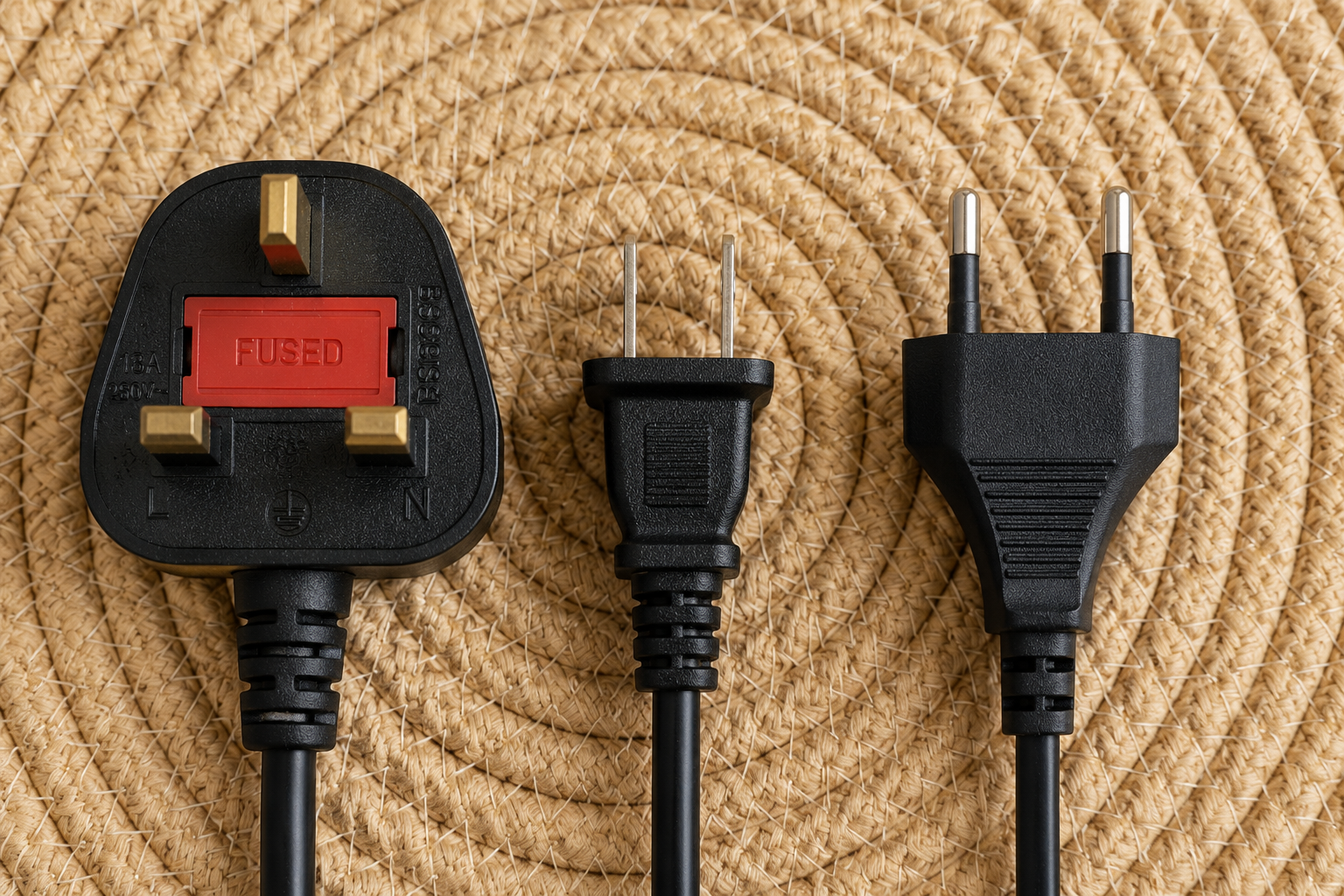
Kenya’s Voltage and Frequency at a Glance
| Specification | Kenya |
|---|---|
| Voltage | 240V |
| Frequency | 50Hz |
| Plug type | G (BS 1363) |
| Socket rating | 13A, fused |
How your home country compares
| Country | Voltage | Freq. | Plug | Adapter? | Converter? |
|---|---|---|---|---|---|
| Kenya | 240V | 50Hz | G | — | — |
| UK & Ireland | 230V | 50Hz | G | No | No |
| USA & Canada | 120V | 60Hz | A/B | Yes | Only for 120V-only devices |
| Mexico | 127V | 60Hz | A/B | Yes | Only for single-voltage devices |
| Most of Europe | 230V | 50Hz | C/E/F | Yes | No |
| Australia & NZ | 230V | 50Hz | I | Yes | No |
| Japan | 100V | 50/60Hz | A/B | Yes | Only for single-voltage devices |
| South Africa | 230V | 50Hz | M/N | Yes | No |
| India | 230V | 50Hz | C/D/M | Yes | No |
Two patterns worth memorising. 230V countries (Europe, Australia, South Africa, India): your voltage already matches Kenya’s — you only ever need the plug-shape adapter, never a converter. 120V countries (US, Canada, Mexico, Japan): your dual-voltage electronics are fine with just an adapter, but any single-voltage device receives double its rated power. That’s the group that must check every charger label.
Will Your Electronics Work? The 10-Second Label Check
Flip over your charger or power brick and find the tiny printed text. If it says INPUT: 100–240V ~ 50/60Hz, you’re safe anywhere in Kenya with just a plug adapter. That covers virtually every phone, laptop, tablet, e-reader, camera battery charger, drone battery, power bank, and smartwatch made in the last decade.
The devices that get travellers into trouble
| Device | The Problem | The Fix |
|---|---|---|
| US hair dryer | Almost always 120V-only. On 240V it fries instantly. | Leave it home. Most Kenyan hotels and lodges provide one, or buy a dual-voltage travel dryer. |
| Curling iron / straightener | Usually single-voltage unless marked “worldwide.” | Check the label; buy a dual-voltage travel model if not. |
| Electric shaver | Older models are single-voltage. | Check the label or bring a battery/USB-charged shaver. |
| CPAP machine | Most modern units are dual-voltage — but verify the brick. | Also pack the DC/battery option for remote camps (see the safari section). |
The plug adapter changes the shape, not the voltage. If your device says 120V only, an adapter alone turns it into a smoke machine.
How Reliable Is Kenya’s Power? (The Part Every Other Guide Skips)
Here’s the honest local picture. Kenya Power runs a largely stable grid in Nairobi, Mombasa, Kisumu, and Nakuru — and over 90% of grid electricity comes from renewables like geothermal and hydro, which we’re quietly proud of. But plan for three realities:
- Brief outages happen. Heavy rains in Nairobi can knock power out for minutes to a few hours. Malls, offices, and mid-range-and-up hotels have backup generators that kick in within seconds — but don’t leave a critical work call to chance without a charged laptop
- Safari lodges run on their own power. Many camps in the Maasai Mara, Amboseli, and Samburu use solar and generators — often with set power hours (commonly 5–10 AM and 6–11 PM), charging stations in the main mess tent rather than in-room sockets, and sometimes a ban on high-draw appliances like hair dryers and kettles
- Rural voltage can fluctuate slightly. Modern dual-voltage chargers shrug this off, but a surge-protected adapter or travel power strip is cheap insurance for camera gear
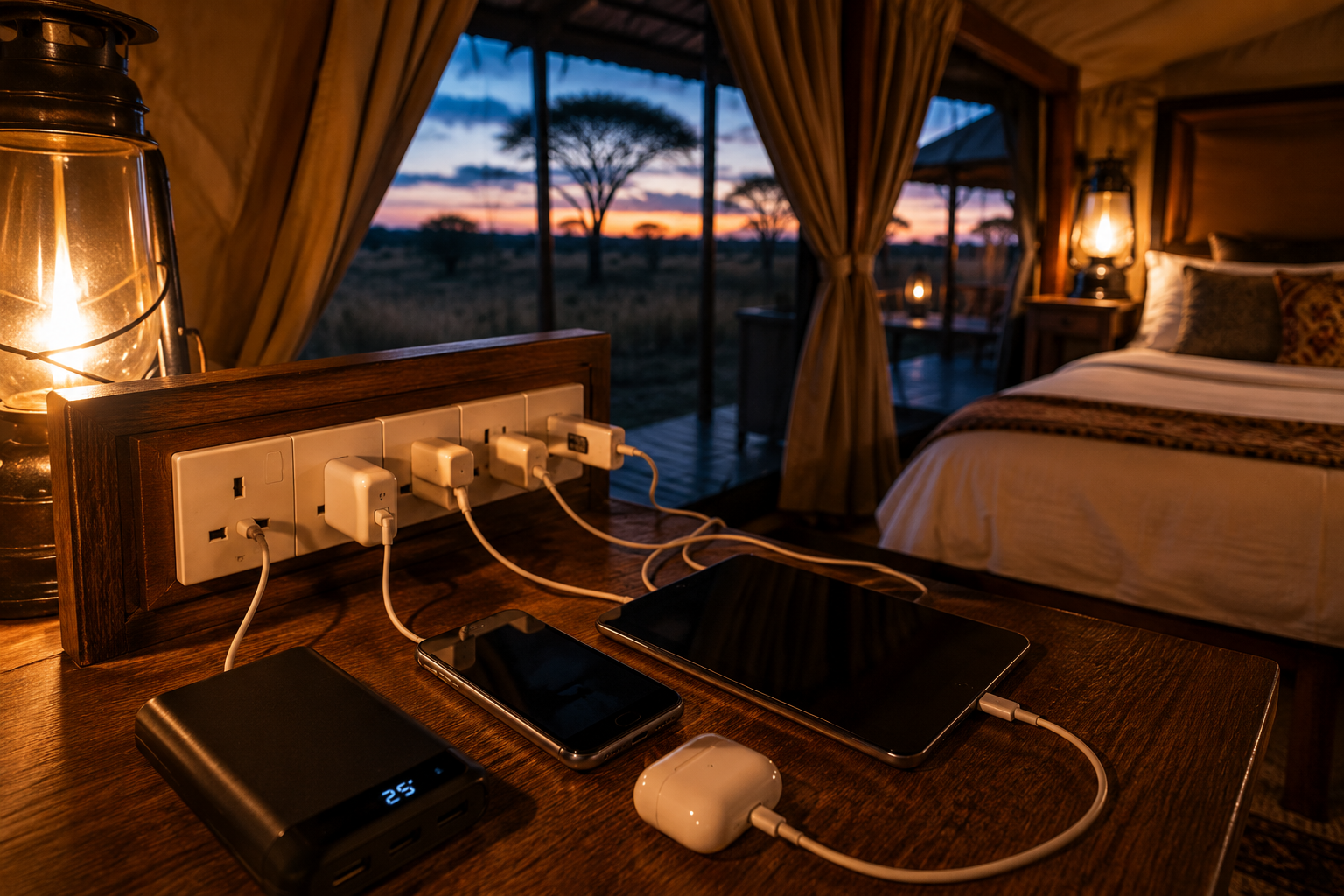
Our safari charging strategy (what we tell every visitor)
- Bring a 20,000mAh power bank — charged nightly, it covers your phone and camera through two full game-drive days. Airline rule: power banks go in carry-on only, never checked luggage, and stay under 100Wh (~27,000mAh). Our pick on Amazon
- Pack a compact travel power strip with USB ports. One wall socket becomes five charging points — you’ll be the most popular person in camp. Our pick on Amazon
- Charge camera batteries at lunch, not overnight. Midday is when solar-powered camps have surplus power
- Carry spare camera batteries. Sockets are scarce; batteries are not
Adapter Advice by Home Country
- Americans & Canadians: You need a Type G adapter — your flat-pin plugs physically cannot enter our sockets. Electronics are fine; heat-styling appliances are not
- Brits & Irish: Congratulations — your plugs work as-is. You can skip to the safari section
- Europeans: Your round two-pin plugs won’t fit, so you need the adapter — but your 230V devices are perfectly happy on our 240V. No converter, ever
- Australians & Kiwis: Adapter yes, converter no
- South Africans: Yes, even as neighbours — your Type M/N plugs don’t fit Type G
Which Adapter Should You Buy? (And Where)
Before you fly is always the best option — better quality, better price, zero arrival stress. Look for genuine Type G output, USB-C Power Delivery (20W+) for fast phone charging, 2–4 USB ports so one adapter covers your whole kit, surge protection, and a recognised safety certification (CE, UL, RoHS) printed on the body — not just the box.
We’ve tested and compared the seven best options — for solo travellers, couples, families, and safari photographers — in our full roundup: Kenya Adapters for Travel (2026). The short version: the TESSAN PD 20W is the best overall for nine out of ten travellers (four AC outlets + three USB ports with genuine 20W USB-C fast charging), the HANYCONY Type G is the smart budget play, and the Ceptics Universal 45W is the pick if Kenya is one stop on a multi-country trip. Couples should grab the TESSAN 2-Pack — adapters are the single most commonly forgotten item in hotel rooms.
If you land without one (a local’s shortlist)
| Where | What to expect | Typical price |
|---|---|---|
| Carrefour (Two Rivers, Sarit, The Hub, Village Market) | Reliable stock, decent quality | KES 500–1,500 |
| Naivas supermarkets | Budget options, hit-and-miss stock | KES 300–800 |
| Electronics shops, Luthuli Avenue (CBD) | Cheapest in town — inspect build quality before paying | KES 200–600 |
| JKIA airport shops | Convenient, tourist pricing | KES 1,500+ |
Skip the KES 100 street-side adapters — loose pins, no fuse, and we’ve seen them spark. Your camera kit is worth more than the KES 400 you’d save.
7 Charging Mistakes We Watch Visitors Make Every Year
- Packing only a USB cable and assuming hotels have USB wall ports. Some do; many don’t
- Plugging a 120V hair dryer straight in. It dies loudly and immediately
- Buying one adapter for four devices. Bring two adapters or one adapter plus a travel power strip
- Putting the power bank in checked luggage. Airlines will confiscate it
- Assuming the safari tent has a socket. Ask your lodge before you travel — many charge devices centrally
- Ignoring surge protection for expensive camera equipment in rural areas
- Waiting to buy the adapter at JKIA at 11 PM after a long-haul flight, when the shops are shut
📄 Free Download: The Kenya Plug & Power Cheat Sheet
One printable page with the quick-answer table, the 60-second charger label check, and country-by-country adapter verdicts. Keep it in your travel folder — or on your phone.
👉 Get the Free Cheat SheetFrequently Asked Questions
Can I use a US plug in Kenya?
No. US Type A/B plugs physically cannot fit Kenya’s Type G sockets. You need an adapter.
Is Kenya 220V or 240V?
Officially 240V at 50Hz. Real-world supply fluctuates between roughly 220–240V, which modern electronics handle without issue.
Can I charge my iPhone or Android phone in Kenya?
Yes — every modern phone charger is dual voltage. You only need the Type G adapter.
Will my laptop work in Kenya?
Yes. Laptop bricks accept 100–240V. Adapter only.
Do Kenyan hotels provide adapters?
Five-star hotels and top safari lodges often lend them at reception (limited stock). Mid-range hotels and guesthouses usually don’t. Bring your own.
Do I need a voltage converter for Kenya?
Only for single-voltage appliances — usually 120V heat-styling tools. Phones, laptops, cameras, and tablets never need one.
Does Kenya use the same plug as Tanzania and Uganda?
Yes — both also use Type G, so one adapter covers the classic East Africa circuit. South Africa is different (Type M/N).
Can I use my CPAP machine on safari?
Check that your unit is dual voltage (most modern ones are), then confirm with your camp whether power runs overnight — many switch generators off at night. Bring the battery pack or DC adapter for remote camps.
What happens if I plug a 120V device into a Kenyan socket?
It receives double its rated voltage: overheating, a popped fuse, smoke, or permanent damage — sometimes within seconds.
Should I bring a power strip to Kenya?
If you travel with a camera rig, drone, laptop, and phone — absolutely. One adapter plus a compact travel strip is the most efficient setup.
The Bottom Line From Nairobi
Kenya runs on Type G plugs and 240V/50Hz power — the British standard, and one of the safest in the world. For 90% of what’s in your bag, a single quality Type G adapter with USB-C fast charging is all you need. Leave the hair dryer at home, pack a power bank for game drives, and confirm your safari camp’s charging setup before you fly.
Get this one small thing right, and you’ll never think about electricity again — you’ll be too busy watching elephants cross the Amboseli plains with Kilimanjaro behind them, camera fully charged. Karibu Kenya.
Next steps: see our tested picks in Kenya Adapters for Travel (2026): The 7 Best Type G Picks That Actually Work, grab the free cheat sheet or the complete Kenya Plug & Power charging guide, and browse our books — including the Kenya Travel Guide 2027.
Last updated: July 2026. Prices and availability on Amazon change frequently — always check the current listing before purchasing.
↑ Back to top